Brightin Star MF 14mm F2.8 Lens: Worth Buying?
What it is
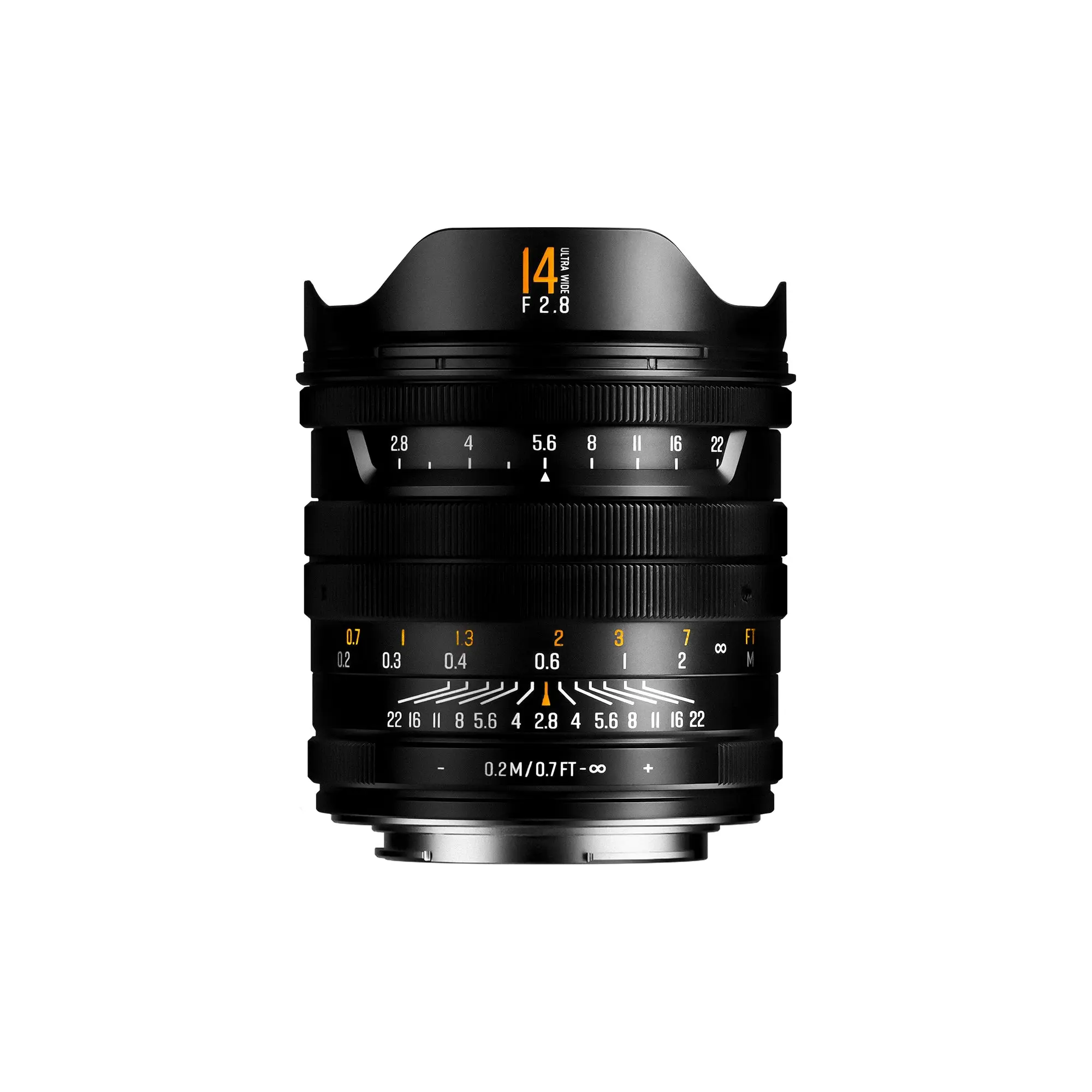
Brightin Star’s MF 14mm F2.8 is a manual-focus, full-frame ultra-wide prime aimed at landscape, architecture, and astrophotography shooters. It’s sold for Sony E, Nikon Z, Canon RF, and Leica L mounts, built around a 13-element, 9-group optical formula (including aspherical and extra-low-dispersion glass), and covers a 116-degree field of view at a bright f/2.8 maximum aperture. There’s no autofocus, no electronic contacts, and no weather sealing — this is a fully mechanical lens with an aperture ring, a distance/depth-of-field scale, and a detachable metal hood built around an 82mm filter thread. You can check current stock and pricing on the Brightin Star MF 14mm F2.8 product page.
What to check before buying
- Pick the right mount. Sony E, Nikon Z, Canon RF, and L Mount are separate listings at the same $279.99 price — ordering the wrong one means a return.
- It’s manual focus only. No autofocus, no image stabilization, and no electronic contacts, so aperture/EXIF data won’t pass to your camera body and there’s no in-camera correction profile.
- Budget for slim filters. The 82mm filter thread is wide, and independent testers warn that thicker filters can physically vignette at this angle of view.
- Corner sharpness needs stopping down. Independent hands-on testing found the center is sharp wide open at f/2.8, but corners soften noticeably from field curvature and only firm up around f/5.6–f/8.
- Watch for flare. Bright light sources in frame (streetlights, the moon, direct sun) produced pronounced colored flare and ghosting in testing, and it didn’t fully clear up when stopped down.
- No weather sealing. Plan accordingly if you shoot landscapes or astro in damp, dusty, or coastal conditions.
Performance
Center sharpness wide open at f/2.8 held up well when tested on a 61MP Sony a7CR, and distortion came in surprisingly low for a 14mm lens. The catch is field curvature: corners fall apart noticeably at wider apertures and only come together around f/5.6–f/8, and bright light sources trigger colored flare and ghosting that persists even stopped down. For a lens marketed toward astrophotography and landscapes — where edge-to-edge sharpness wide open matters most — that’s a real limitation, not a minor quirk.
Durability
The all-metal barrel and smooth (if slightly heavy) manual focus ring feel solid for a lens at this price, and Brightin Star backs it with a 2-year warranty and 90-day returns through the official store. There’s no weather sealing, though, so it isn’t built for shooting in rain, spray, or heavy dust — a relevant gap for a lens aimed at outdoor landscape and night-sky work.
Ease of use
This is a fully manual lens: no autofocus, no stabilization, and no electronic contacts between lens and body. The aperture ring, distance scale, and depth-of-field markings make manual work straightforward once you’re used to zone focusing, but it’s not a grab-and-shoot lens for beginners or anyone who wants autofocus confirmation for night work.
Hidden costs
The lens ships with a metal hood in the box, which helps. But the 82mm filter thread is on the larger side for this lens class — budget extra for slim-profile filters to avoid vignetting, especially if your existing ND or polarizer filters are a different thread size.
Value
At $279.99, the MF 14mm F2.8 undercuts most full-frame 14mm f/2.8 alternatives from Samyang/Rokinon and sits close to lighter options like the TTArtisan 14mm F2.8 ASPH. The metal build, included hood, aperture ring, and 2-year warranty look good on paper for the price. Whether that value holds up depends heavily on how the corner softness and flare issues affect your specific use: video shooters working in controlled light and landscape shooters happy to stop down to f/5.6–f/8 get more out of it than astro shooters chasing sharp corners wide open.
Verdict: Bypass
In hands-on testing published by Fstoppers (reviewer Christopher Frost, June 2026), the Brightin Star MF 14mm F2.8 delivered a sharp center wide open and unusually low distortion for a 14mm lens — genuinely good results for $279.99. But the same testing found significant field curvature that softens corners at f/2.8 through roughly f/4, plus flare and ghosting around bright light sources that doesn’t clean up when you stop down. Those two issues cut directly into the lens’s main selling points: wide-open astrophotography and landscape work, where corner sharpness and clean handling of point light sources (stars, streetlights, the moon) matter most.
If you mainly shoot 4K video in controlled lighting or landscapes you’re happy to stop down to f/5.6–f/8, the price and build quality make this lens usable. But as an ultra-wide prime for its two headline use cases at full aperture, BuyOrBypass’s call is Bypass — the optical compromises are significant enough that a lens promising 116° astro-and-landscape performance should be judged against, not around, its widest aperture. You can still compare pricing and mounts yourself on the official Brightin Star product page before deciding.