ENGWE P275 SE vs M20: Which ENGWE E-Bike Should You Buy?
ENGWE P275 SE vs M20 is the choice most European riders face when they shortlist ENGWE: one is a step-through city commuter, the other a moped-style fat-tire bike with full suspension. They sit only €100 apart on ENGWE’s EU store, but they solve very different problems. Here is how they compare on price, range, weight, comfort and the costs nobody puts in the headline.
Disclosure: BuyOrBypass may earn a commission if you buy through our links, at no extra cost to you. We have not ridden these bikes ourselves; this comparison is built from ENGWE’s own product pages, independent long-term tests and owner ratings, with sources named below.
Quick verdict: For daily commuting on paved roads, pick the ENGWE P275 SE (€999 on November 24, 2026): it is about 10 kg lighter, goes further on a charge in independent testing and uses a smoother torque sensor. Pick the ENGWE M20 (€1,099 single battery, €1,299 dual) only if you want full suspension and fat tires for rough paths and you never have to carry the bike upstairs.

ENGWE P275 SE vs M20 at a glance
| Spec | ENGWE P275 SE | ENGWE M20 |
|---|---|---|
| Price on engwe.com (Nov 24, 2026) | €999 (compare-at €1,499) | €1,099 single battery / €1,299 dual battery |
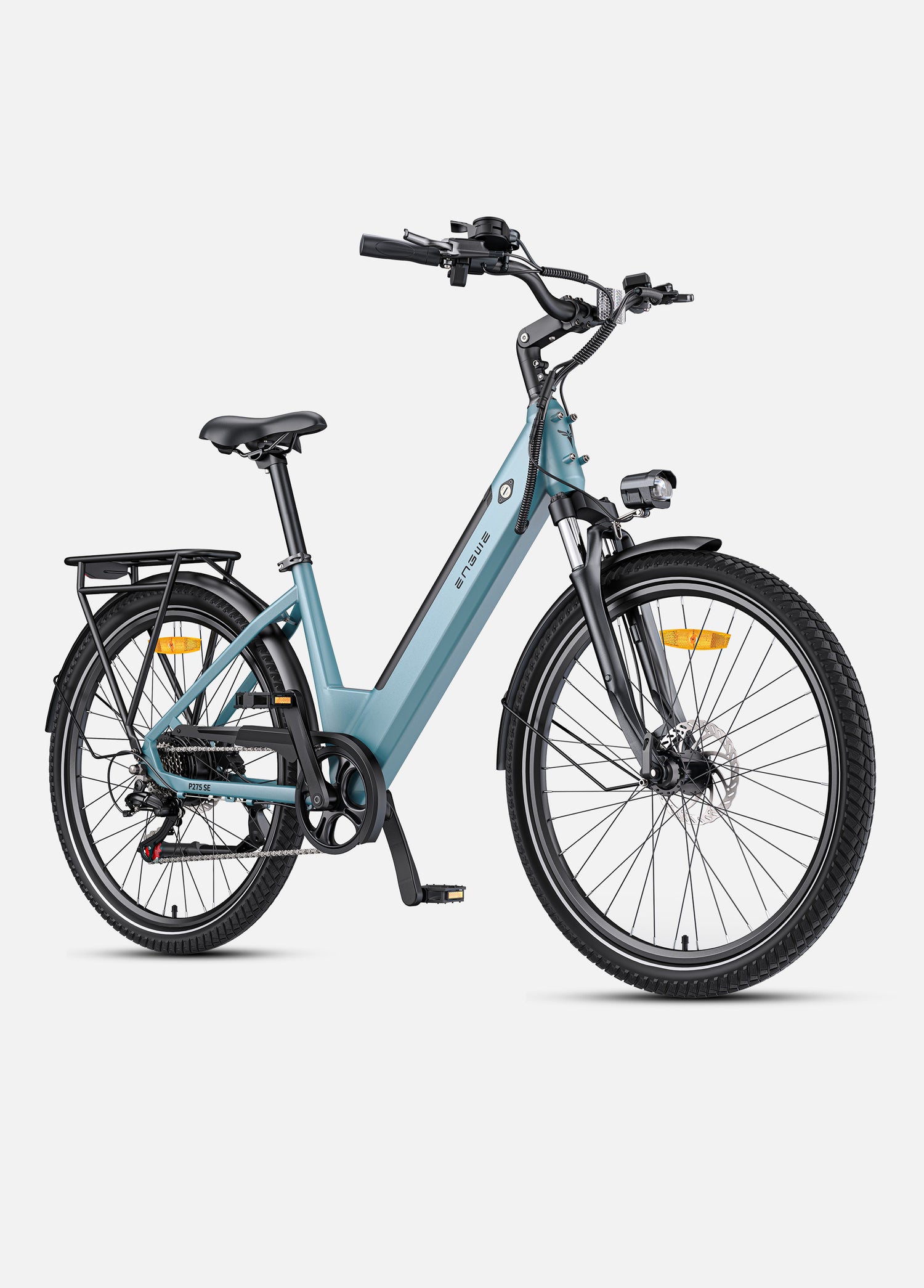
| Style | Step-through city commuter | Moped-style fat-tire e-bike |
| Motor | 250W rear hub, 55 Nm, torque sensor | 250W rear hub, 55 Nm (EU version) |
| Battery | 36V 13Ah (468Wh), removable | 48V 13Ah, second pack optional |
| Claimed range | Up to 100 km | Up to 75 km per battery |
| Independent range test | About 98 km (lowest assist, flat routes, ERideHero) | About 45 km (hilly loop, one battery, BikeRadar) |
| Weight | About 24 kg listed (25.8 kg measured by one tester) | 34.8 kg |
| Tires | 27.5 x 1.95 in city tires | 20 x 4.0 in fat tires |
| Suspension | Not highlighted on the product page | Hydraulic fork + rear air shock |
| Brakes | 160 mm hydraulic discs | 160 mm discs front and rear |
| Gears | Shimano 7-speed | Shimano 7-speed |
| Top assisted speed (EU) | 25 km/h | 25 km/h |
| Included extras | Fenders, rear rack, lights | Check listing for your colour and version |
Prices were read from ENGWE’s EU store on November 24, 2026 and can change at any time. Specs come from ENGWE’s product pages; test figures come from the independent reviews named in each section.
Price: the real gap is bigger than €100
On paper the M20 costs only €100 more. In practice most buyers who choose the M20 end up looking at the dual-battery version, because the single-battery range is the M20’s weak point. That makes the realistic comparison €999 against €1,299, a €300 gap.
Both bikes also show large “was” prices. The P275 SE is listed against a €1,499 compare-at price, which is where the “€500 off” message comes from. Judge it at €999, which is what you actually pay. The M20 had no compare-at price on the listing we checked today, so the €1,099 and €1,299 figures are simply its current prices.
Want today’s numbers? You can check the ENGWE P275 SE price or check the ENGWE M20 price on ENGWE’s EU store.

Ride feel: torque sensor vs fat-tire comfort
This is the biggest practical difference between the two bikes, and it is easy to miss on a spec sheet.
The P275 SE uses a torque sensor. Instead of switching the motor on as soon as the pedals turn, it measures how hard you push and adds power in proportion. ENGWE says its system reacts in about 50 milliseconds. In ERideHero’s long-term test, the reviewer called the pedal feel the most natural he had tried on a hub-motor bike at this price. For stop-and-go city traffic, that smoothness matters every single ride.
The M20 is about comfort and presence rather than finesse. The 4-inch tires, hydraulic fork and rear air shock soak up broken tarmac, gravel and curbs. BikeRadar gave it 3.5 out of 5, praising strong acceleration and composed handling, while noting that it struggles on steep hills and drains the battery quickly in the highest assist levels.

Range: where the P275 SE pulls clearly ahead
Range claims on e-bikes are often optimistic, so we lean on independent tests.
- P275 SE: ENGWE claims 100 km in the lowest assist level, 80 km in level 3 and 65 km in level 5. ERideHero, with a 79 kg rider on mostly flat city routes, measured roughly 98 km, 83 km and 71 km. That matches or beats the claim.
- M20: ENGWE claims up to 75 km per battery in the lowest level. BikeRadar measured about 45 km on a hilly loop with one battery. Different routes make this an imperfect comparison, but the gap is large enough to matter.
If your commute is 20 km each way, the P275 SE should cover a round trip with room to spare. A single-battery M20 on hilly roads would be cutting it closer, which is why the dual-battery version exists.

Weight and storage: 24 kg vs 34.8 kg
The M20 weighs 34.8 kg. The P275 SE is listed at about 24 kg, and one independent scale reading put it at 25.8 kg with the battery. Either way, the M20 is roughly 9 to 11 kg heavier.
That is the difference between lifting a bike up three steps without thinking and needing a lift or ground-floor storage. If you live in an apartment without an elevator, this one number may decide the whole ENGWE P275 SE vs M20 question for you.

Hills: both bikes have the same limit
Both bikes use a 250W, 55 Nm rear hub motor in their EU versions, so neither is a strong climber.
- On a 17% climb, the P275 SE tester’s speed dropped to about 10 km/h in the highest assist level with extra leg effort.
- BikeRadar found the M20 struggles on climbs steeper than about 10%, and it carries roughly 10 kg more up every hill.
If your daily route includes steep hills, neither bike is ideal. A mid-drive motor would suit you better, and that usually means a higher budget.
The catch: 4 costs and traps to check before you pay
These are the details that change what each bike really costs you.
- Non-defective returns are expensive (P275 SE page policy). ENGWE accepts returns within 30 days only if the bike shows under 10 km, and it deducts a €200 shipping fee per bike plus a restocking fee for non-defective returns. On a €999 bike, a change of mind can cost you over 20% of the price.
- Extended warranty prices differ a lot. The P275 SE’s one-year extension was listed at €50 (down from €99) when we checked on November 18, 2026. The M20’s optional one-year extension was €119.90 in our September 2026 research. The P275 SE page also shows both a “1-2 Year Warranty” icon and a “24 Months Warranty” section, so ask support which parts get which term.
- Range upgrades are not cheap. A spare P275 SE battery listed at €259. On the M20, the dual-battery version adds €200 to the price.
- A good lock is effectively mandatory. The P275 SE’s battery locks with a key, but the frame has no built-in anti-theft and the app lock did not work reliably in testing. The M20’s moped look attracts attention. Budget for a quality lock either way.

Long-term cost over the first year
Here is a simple first-year estimate using only prices we could confirm on ENGWE’s store:
| Item | P275 SE | M20 (dual battery) |
|---|---|---|
| Bike | €999 | €1,299 |
| Extra-year warranty (optional) | €50 | €119.90 |
| Spare battery or second pack | €259 (optional) | Included in the €1,299 version |
| Fenders and rack | Included | Check the listing |
| Lock | Your choice | Your choice |
Without a spare battery, the P275 SE plus warranty comes to €1,049. The dual-battery M20 plus warranty comes to €1,418.90. That is close to a €370 difference before you add a lock.
How they compare with a brand you know
Decathlon’s Elops 920 E is the best-known European city e-bike in this class. It uses a 50 Nm Brose mid-drive motor and a 417Wh battery, and French retailer Roulez Jeunesse listed it at €1,499 to €1,799 in our earlier research. The P275 SE costs €999 with a larger 468Wh battery and a torque sensor, so it saves €500 or more. The trade-off is hill climbing: a mid-drive handles steep climbs better than either ENGWE hub motor, and with Decathlon you can walk into a store for service.
The M20 does not have a direct Decathlon equivalent. Its selling point is full suspension plus fat tires at €1,099 to €1,299, a combination that usually costs more from well-known brands.

What owners and testers say
We use two kinds of sources: independent tests and large pools of buyer ratings.
- ENGWE as a brand: Trustpilot showed 4.1 out of 5 from 2,111 reviews, with 77% five-star and 16% one-star ratings, when we checked on November 18, 2026. That one-star share is worth noting for a bike you buy online.
- M20 on ENGWE’s store: 319 reviews with 95% five-star in our September 2026 check. Store reviews are curated by the seller, so we weigh them below independent tests.
- Independent tests: ERideHero’s long-term P275 SE test found the range claims hold up; BikeRadar rated the M20 3.5 out of 5.
Read our full reviews for more detail: the ENGWE P275 SE review and the ENGWE M20 review. If you also want a folding option, see our ENGWE Zip review.

Setup and everyday use
Neither bike is plug-and-play. Expect around 30 minutes of assembly for the P275 SE, plus a possible tweak to brake and gear-cable tension out of the box. Reviewers needed about an hour to finish the M20, and noted its printed instructions are not very clear.
Day to day, the P275 SE is the easier bike: step-through frame, upright posture, five distinct assist levels and a one-click removable battery. Its companion app adds little and was buggy in testing. The M20 is simple to ride once built, with an LCD display and 7 gears, but its long, low seat and single frame size suit fewer body types. The P275 SE fits riders roughly 155 to 185 cm tall.

Who should buy which
Buy the ENGWE P275 SE if you:
- Commute on paved, flat-to-rolling roads in the EU
- Need to carry the bike up a few steps or store it indoors
- Want the longest range for the money and a natural pedal feel
- Prefer fenders and a rack in the box
Buy the ENGWE M20 if you:
- Ride gravel, broken tarmac or park paths and want full suspension
- Like the moped look and have ground-floor or garage storage
- Are willing to pay for the dual-battery version for usable range
Skip both if you:
- Have steep hills (over about 10% to 17%) on your daily route
- Live in the US: these EU-spec models and prices are for ENGWE’s European store
- Are unsure about the bike: a non-defective return costs at least €200

Verdict: ENGWE P275 SE vs M20
Research Pick for commuters: ENGWE P275 SE. It is cheaper, about 10 kg lighter, smoother to pedal and goes much further on a charge in independent testing. For most people riding to work or school on European roads, it is the safer buy. See the ENGWE P275 SE on ENGWE’s EU store.
Research Pick for comfort on rough paths: ENGWE M20, dual battery. Choose it only if suspension and fat tires matter more to you than weight and range, and you have easy storage. See the ENGWE M20 on ENGWE’s EU store.
During Black Friday week we re-check ENGWE prices daily on our Black Friday price check page.
Get BOB’s Deal Alerts
FAQ
Is the ENGWE P275 SE or M20 better for commuting?
The P275 SE. It is lighter, has a torque sensor for smoother assistance, and independent testing measured about 98 km of range in the lowest assist level on flat routes, compared with about 45 km for a single-battery M20 on a hilly loop.
Are the ENGWE P275 SE and M20 road-legal in the EU?
Yes. The EU versions use a 250W motor and stop assisting at 25 km/h, which matches EU pedelec rules.
Which is better on hills?
Neither is strong on steep hills. Both use a 250W, 55 Nm rear hub motor. The P275 SE is about 10 kg lighter, which helps, but riders with climbs steeper than about 10% should consider a mid-drive bike.
Can I buy these bikes in the US?
The prices and specs in this comparison are for ENGWE’s EU store, which does not ship to the US. US buyers should check ENGWE’s US store, where models, specs and rules differ.
How much does it cost to return an ENGWE bike?
For non-defective returns within 30 days, ENGWE requires under 10 km on the display and deducts a €200 shipping fee per bike plus a restocking fee, according to the policy shown for the P275 SE.
Sources: ENGWE official EU product pages for the P275 SE and M20 (prices checked November 24, 2026); ERideHero long-term P275 SE test; BikeRadar ENGWE M20 review; Trustpilot ENGWE page (checked November 18, 2026); Roulez Jeunesse listing for the Decathlon Elops 920 E. Images: ENGWE official store.